Overview
We define information in CRO in a narrow sense as something carrying meaning. Meaning is understood in the sense of human communications, such that receipt of information carrying artifact will increase the knowledge of the receiver on some topic. Meaning ultimately only obtains within the mind of a conscious agent, and therefore the meaning carried in CRO information is a mind-dependent entity, however the information itself is mind-independent, since its persistence is not dependent on minds as such.
1. What Kinds of Information are there?
One might naively imagine that information created in social realities can take any form, be about anything, and that consequently there could be no possible approach to ontologising it. However, outside of pure artistic pursuits, in most human disciplines things are surprisingly simple in the abstract, if we view them in an appropriate light.
To provide an initial conceptual structure, CRO makes the assumption that we live and work in technologically enabled, specialised, and institutionally oriented societies, which are heavily dependent on durable information and knowledge accumulated over time. Such descriptions of society may be found in cite:[Luhmann1995SocialSystems], cite:[Luhmann2012TheorySociety1], cite:[Hardwig_1985], cite:[Searle1995ConstructionSocialReality], cite:[Searle2010MakingSocialWorld] and numerous others.
We informally assume that the following cognitive functions in such societies are likely guides to ontological categories of information:
-
describing the world:
-
data gathering - fine-grained observations made in the real world;
-
describing phenomena - building informational representations of real world entities such as patients, operating machinery, ecosystems;
-
knowledge production - creating and documenting categorial knowledge in textbooks, engineering specifications, reports;
-
-
ordaining changes - creating laws, prescribing medicines, legal documents;
-
documentation of steps of long-running work processes.
2. Describing the World
The first three sub-categories above relate to how we obtain and create our knowledge of the world. We initially have to make observations, i.e. create data to work with. We aggregate pieces of data to provide a picture of complete individual entities, such as the health of a person, or the state of an ecosystem. Via methodological modes such as the scientific method, we consolidate numerous instances of knowledge of individuals to create categorial knowledge, for example a description of what diabetes mellitus is. Such knowledge is typically documented in textbooks and educational course materials. We also create much institutional information and knowledge, such as the usual working methods, reports, audits and so on of any working organisation.
CRO provides categories for all three types of description.
Domains such as science, natural history, anthropology, and journalism consist in detailed observation, analysis and the writing up of the same. All have substantial bodies of accumulated knowledge as a result.
We may distinguish between descriptions of individuals and knowledge as being used in different ways. The former are used operationally, that is, to perform work on specific cases, such as patients, aircraft, and wineries. Knowledge-level information provides the capability for specialists (doctors, mechanics, etc.) to perform their work in a successful way.
3. Changing the World
The next distinction to make is between describing the world and changing it. Nearly every area of human activity at least involves observation and therefore description. Many other domains, such as medicine, law, defence and politics involve both description and change.
Creating change in social reality can be best understood as certain varieties of speech act (in the sense of Searle cite:[Searle_1979]) and document that create obligations on certain parties for the future. For example, a doctor’s prescription creates an obligation for a pharmacy to provide medicine to a patient; an invoice creates an obligation on one party to pay another within a certain time, and on the first to provide the product or service stated in the invoice.
CRO therefore includes a sub-category for deontic documents, a term inspired by Barry Smith’s Document Acts cite:[Smith2014DocumentActs], a synthesis based on Searle and Austin. A deontic document is understood as a bearer of deontic powers between / among agents that creates obligation. It includes such things as prescriptions, contracts, powers of attorney, licenses, wills, invoices, and permits.
4. Completeness
CRO makes the further assumption that organised human activity (again, outside of artistic or purely pleasurable pursuits) takes the form of processes designed to achieve certain goals, and that for such goals to be met, both descriptions (evidence for decision-making) and deontic documents (the result of decisions) will be created.
We now make a further observation: for either kind of entity to be useful to its users, it needs to be sufficiently comprehensive with respect to its scope. That is to say, it needs to be complete (in some pragmatic sense), and maintained over time, so that it can be safely used for its purpose.
Consider the clinical process around a patient who is eventually diagnosed with cancer. Prior to diagnosis, most of the clinical work is designed to build up a sufficiently complete picture of the patient to document and make sense of the symptoms, make a diagnosis, and embark on treatment. The result of this work is a comprehensive description of the patient, which we may think of as an approximate digital twin. Even once the physician makes the diagnosis, and treatment is commenced, maintenance of the digital twin is essential to track patient progress.
Similarly, we may consider the deontic document representing the patient’s chemotherapy plan, such as the CHOPS21 regime used over six weeks. This also needs to be constructed for the patient and completed to the point where it can be executed - oncology nurses cannot commence administration of a chemo plan that is not completed, reviewed and signed off in some way.
In the legal realm we can find equivalents: the description of the production capabilities of company A needs to be completed sufficiently for work on a joint venture to commence; and the joint venture agreement between company A and company B itself needs to be completed in order to come into legal force.
5. The Information Lifecycle
We may now ask the question: how do descriptions and deontic entities come into being? CRO makes the assumption that the work to create either kind of informational entity unfolds over time, via an epistemic process consisting of incremental steps, such as a diagnostic pathway, or the workflow to put together a new employment contract. We make this assumption even if the first version of the new artifact is made by copying an existing artifact and subsequently making minor modifications.
We denote the work process as an investigator process, and assume that it has a certain form and that it generates incremental statements at each step, describing what was observed, decided, done etc. The general cognitive model of such a processes is an extended epistemic one, which means knowledge gathering plus issuing of requests, orders etc (the 'extended' part). This is described in more detail below.
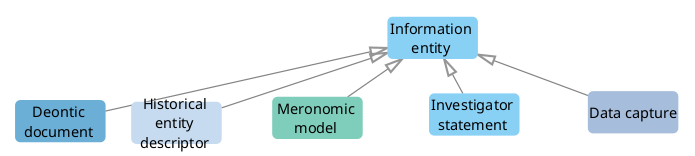
The considerations so far bring us to the following categories of information entity:
-
data items - raw measurements and other fine-grained capture of the state of reality;
-
description - express comprehensive historical / current state of some X;
-
deontic documents - comprehensive description of what should be done in the future;
-
investigator statement - incremental process step reports which contribute to the construction of full descriptions and deontic entities;
-
knowledge - categorial descriptions of kinds of entity and phenomena in the world.
6. Models and Instances
The above categories provide the conceptual distinctions between the key kinds of information in reality. We make an addition from the world of engineering and information technology (IT), which is that models of all of the above are routinely used to capture the semantics of commonly occurring content. For example, descriptions of the same patient vital signs for 10 or 1,000 or a million patients should be the same structures, plus or minus whichever accidental elements may or may not be present. Similarly, employment contracts, at least within certain sub-categories, are all the same other than for the individual details, for a given company. In general we do not want descriptions, deontic content or investigator statements to each be their own thing, but instead to conform to appropriate natural kinds, i.e. such things as model of blood pressure measurement, plan for chemotherapy administration and so on.
Models themselves are a sub-class of CRO Information entity, and they provide the category of which actual models used in engineering and IT are existential instances.
CRO terms this kind of model in general as 'meronomic', i.e. based on recursive representation parts and sub-parts.