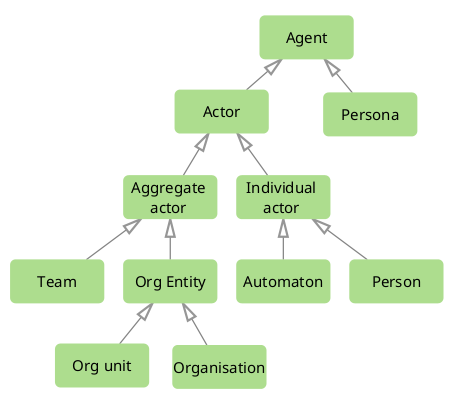
Agent
1. Basis
CRO’s organising principle is the description of cognitively capable entities and the objects of their cognition. The latter include the material, processes, information-carrying and purely mental entities. An intentional agent is thus not treated differently from a (material) device - in business reality, they are both likely to be resources, participate in processes, have associated costs, value, and be employed, owned or leased by a company.
CRO accordingly treats intentional agents as independent continuants (in BFO terminology), rather than realisations of specifically dependent continuant (SDC) realisable entities, such as BFO:Role, which are in any case insufficient to account for agents that may undertake many roles, participations and so on.
In BFO, an agent is subordinate to its material bearer. This is not how the business world generally works. A 'social person', such as represented in a government or bank database is treated as a legal entity in its own right, and it is simply assumed that there is a corresponding material entity i.e. a real physical person, once an initial identification process has been completed.
Intentional agents have relations, including contracts (e.g. employment), agreements (e.g. delegation), accountabilities, ownership, availability (as resources) and other characteristics stemming from their place in social reality. We informally term all such entities as social entities within CRO.
| Note that in CRO, the term 'social' means the world of business, law, and social relations, not 'social media', which is a specific sub-domain of IT. |
The defining differentiator of social entities is agency, which is a capability only found in autonomous goal-directed agents such as humans and autonomous robots (and to a limited extent in higher animals). Social processes tend to be goal-driven, whereas purely physical processes are not.