Top Level
1. Historical Reality and Abstracta
The top-most distinction in CRO is between Historical and Abstract entities, classified under the ultimate top entity Cognitive entity. Informally, these categories may be understood as 'reality' and pure 'ideas', respectively.
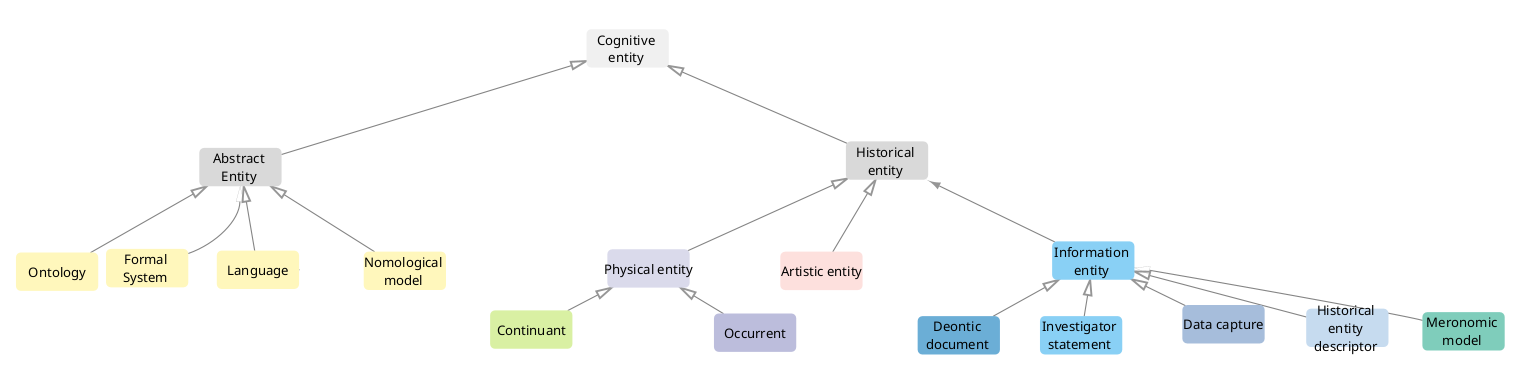
Following Ghiselin cite:[Ghiselin1974-GHIARS] and Hull cite:[Hull1978-HULAMO], a Historical entity is any real individual or kind that is recognised or exists within the history of its world. For example, a particular Jane Holmes from SLC, Utah; a biological species; the AirBus A3xx lineage of aircraft; the US declaration of independence. They thus encompass not only simple individuals but 'natural kinds as individuals', i.e. that are either innately such (biological species) or are considered such by organisations, e.g. product 'platforms' and 'product lines'.
Historical entities are distinct from abstract universals such as Person and Aircraft, which may only appear in abstract descriptions such as ontologies.
In contrast, the Abstract entity category classifies things that are outside time, space, and any reality, i.e. that exist independently of any world. Entities such as languages (both human and machine), mathematics, logic and nomological models (such as the wave equation) fall under this category.
2. Possible Worlds
Since a Historical entity is a real thing, it is instantiated in some world, which might be the real world, or an alternate reality, such as created by a work of fiction or a simulation, and is located at some point or interval within the temporal history of its world. Consequently, one of the key concepts built into CRO is the notion of world, which is a bounded reality.
Metaphysically we assume just one 'real' world, denoted "world-0", with simulated and other realities being understood as virtual, i.e. imaginary. However, we want to allow the possibility of information that reports on any such reality, and to be able to compute with such information in the same way as we do with world-0 information. This allows, for example, querying and reporting on simulation runs in public health, aviation and for defence purposes. Consequently, the shape of information from a simulation of reality (e.g. of a new pandemic) is the same as that from world-0; the ontology of entities reported on in both is the same. In the case of alternate realities, we don’t consider entities located there to really have been instantiated, but that the information that we have about it reflects the reality that would have obtained had it been the path of our real world. (We ignore for our purposes here radically different possible worlds that have different physics and chemistry.)
In consequence of the above, both instances of Information entity and the entities they refer to or represent are Historical entities (including concrete kinds) within some world. The information may have been generated by ordinary means of business and healthcare, by simulation, or as a creative exercise.
TODO: determine whether a 'world' marker on information entities appears in the ontology, or only as a technical data items within the derived information models.
3. Information as a Part of Reality
Under the category Historical entity, CRO defines Physical entity, which is a modified form of BFO; Information entity; and Artistic entity. Information entities are considered to exist in historical reality, as if they were physical. This means their creation and possible destruction can be located in the historical timeline of the world in which they are found.
Information entities can report on:
-
Physical phenomena (including mental experience);
-
Other information artifacts, e.g. previous entries in a patient or aircraft maintenance record;
-
Artistic entities.
TODO: an Information entity can also contain content based on an abstract entity such as mathematics, e.g. a mathematical proof.