Statement
1. Overview
In order to build a comprehensive Physical twin (i.e. digital twin), a Deontic document, or to perform any work specified in the latter, work is performed over time, including the gathering of information. This might be somewhat slow and manual, as it is in medicine, or it may be near real time, as with an industrial control system.
CRO considers all such work to be instances of a process type investigation, Here we understand 'investigation' in its widest possible sense, to include personal introspection of a subjective experience (pain, taste, mental imagery etc), to controlled scientific and legal investigations of biological and social phenomena.
Incremental Information entities created over the course of an investigation come under the category Investigator statement in CRO.
Disciplines whose goal is more than just observation but action (e.g. medicine, law, defence) undertake further problem-solving steps, and generate further kinds of information, such as assessments, orders and so on. We consider these epistemic as well, although they are stretching the usual philosophical understanding of the scope of epistemology, which is knowledge gathering.
Each CRO Investigator statement is a statement of some kind made within an investigational effort, where nothing is assumed, and consequently:
-
there are no 'brute facts', only statements about what appears to exist, how to interpret it, and what to do about it;
-
the process may continue over time, iterating on the phenomena of interest;
-
information provenance, quality and certainty are recorded where possible.
The kinds of statements possible depend on the assumed model of investigational processes.
2. Speech Acts
One way to understand the extended taxonomy of 'statement' types described above is via the concept of speech acts, from Searle cite:[Searle_1979].
Speech acts are communication acts designed to assert and / or change something in the world. In Searle’s scheme there are five categories of speech act, as follows:
- assertives
-
statements, claims, reports about the real world;
- directives
-
orders, commands etc.;
- commissive
-
promises, commitments;
- expressive
-
expressing the psychological state of the speaker, e.g. thanking;
- declaration
-
fiat pronouncements that change reality, e.g. creation of a new company.
TODO: more here
3. Kinds of Investigator Statement
CRO bases its Investigator statement sub-classes on these categories, with refinements, to define the following types of statement.
- Observation
-
an assertion about the state of some entity, as obtained by measurement, from sense data, consumption of media (e.g. reading a document) or by introspection.
- Assessment
-
an assertion about the meaning of Observation(s), such as a diagnosis in medicine. An assessment is really an inference made by comparing Observations about an individual entity to a knowledge base, in order assert the significance of the observations.
- Goal
-
a statement about the intended future state of some part of reality, such as the patient’s weight, or production throughput of a chemical pipeline.
- Order
-
a directive to perform certain actions.
- Action report
-
an assertive reporting on an action undertaken.
These are shown below:
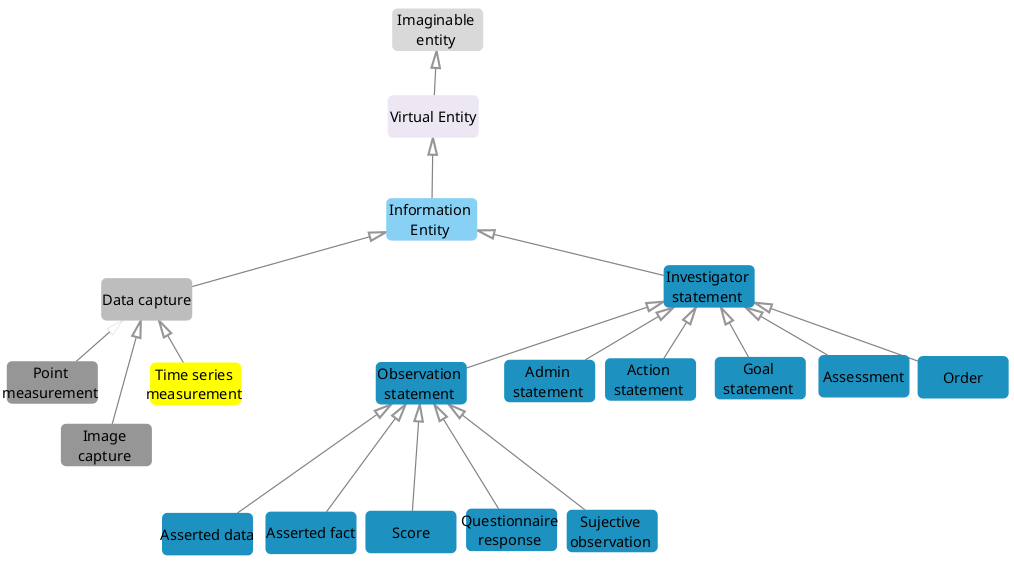
We may now compare the Observation statement class to the Individual PT class: the latter corresponds to a comprehensive picture of some independent entity in reality, while the former is an incremental fragment resulting from a single observation action.
One question of interest is how Statements connect to the Physical entity part of CRO. CRO considers speech acts to be social communications related to the participation of agents in social processes. Thus, a 'medication order' is a communication act of a physician participating in a healthcare process whose subject is the patient, and which has other generic participants that are pharmacies. It creates at least a communication request (the actual speech act), and may also create Task descriptions, i.e. how to perform the request.
Every Statement entity is accordingly assumed to be created by an Agent participating in an Investigation process.